
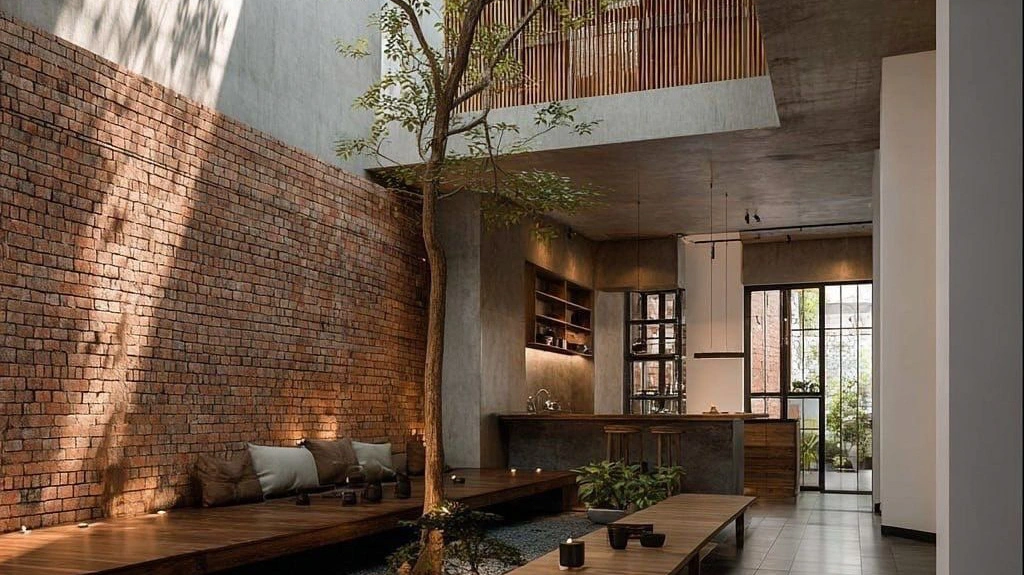
There was a time when homes didn’t need to speak about wellness.
They simply enabled it.
Natural light was not a feature. Ventilation was not a selling point. Open space was not a luxury.
They were defaults.
Today, these same elements are being reintroduced as premium offerings. And that tells us something important — we are not progressing forward as much as we are correcting something we lost.
If you look at the Indian housing market closely, the shift is not subtle anymore. Residential sales have grown nearly 77% between 2019 and 2025, luxury housing demand is expanding at 15–25% annually, and 63% of all homes sold today fall into the premium segment.
This is not just market growth. It is a change in intent.People are no longer upgrading homes.
They are upgrading how they want to live.
At the same time, “wellness real estate” has become one of the fastest-growing narratives in the industry. The segment itself has doubled from $6 billion in 2019 to nearly $13 billion in 2024.
But the real question is not how big this market is becoming.
It is why it is growing.
Urban stress, lifestyle diseases, and the constant need for recovery have made wellness a necessity. But if we are honest, wellness today is less about evolution and more about compensation.
We are trying to fix environments that were never designed to support us.
This is where the distinction becomes important.
- Wellness is what we do with our effort, setting routines & then corrections.
- Wellbeing is what we live in , our environment, its design & condition
One requires discipline. The other requires design. And increasingly, buyers are beginning to sense this difference.
The persona of the the modern buyer especially HNIs and new-age entrepreneurs has fundamentally changed. Today’s buyer has:
- Seen global standards of living
- Experienced better-designed environments
- Understood the hidden cost of stress
And so the question has quietly changed.
Not “Is this a good property?”
But “Is this how I want to live every day?”
This has redefined luxury.
For decades, luxury was external and something visible.
A larger home, a better address & a statement.
Today, luxury is internal.
It is about how a space feels when no one is watching.
This is reflected in behaviour as well. Home sizes have increased by ~17% in top cities, and there is a growing preference for:
- Natural ventilation
- Green integration
- Lower density living
India’s green building market alone is projected to touch $39 billion by 2025.
This is no longer aesthetic preference but is intelligent living.
Hyderabad is a perfect reflection of this shift.
It now contributes nearly 18% of India’s luxury housing demand, driven by infrastructure growth, entrepreneurial wealth, and global exposure.
But growth has come with a cost.
Higher density.
Standardised living.
Reduced personal space.
Which creates a paradox:
The more the city offers outside…
the more people begin to demand from what they experience inside their homes.
And yet, most of the industry is still responding the same way.
By adding wellness.
Gyms. Yoga decks. Clubhouses.
Useful, but limited.
Because these are activities.
Wellbeing is not an activity.
It is a condition.
And conditions are not added.
They are designed.
This is where the future of housing is heading.
Not towards more amenities, but towards better architecture.
Homes will increasingly be valued not by what they offer occasionally, but by what they do consistently:
- Do they reduce stress without effort?
- Do they improve clarity without interruption?
- Do they support life without needing correction?
That is the next benchmark.
At Leonaara, this was not approached as a trend to follow, but as a question to answer:
Why should a home require recovery at all?
That question changes everything.
It shifts the focus from adding features to designing conditions where openness, light, air and space are not external luxuries, but internal experiences. Where density is not optimised but consciously reduced. Where ownership does not come with operational burden.
Not as a statement but as a response to where the world is already moving.
From an investor’s lens, the direction is clear.
Premium housing is leading the market. Experience-led living is outperforming standard formats. Sustainability and space are becoming non-negotiable. But beyond all of this, one deeper truth is emerging:
The value of a home is no longer defined only by where it is it is defined by how it allows you to live.
For decades, homes were built for efficiency. Then they were built for status. What comes next is far more fundamental. Homes built for human experience. And in that shift Wellness will remain something we pursue. But wellbeing will define where we choose to live.